Ronda: The Puente Nuevo, the El Tajo Gorge and the White Villages of Andalusia
Two days in southern Spain’s most theatrically-set town — a 100-metre stone bridge across a gorge, the village above and below, and the white villages in the hills around.
📍 Ronda, Spain
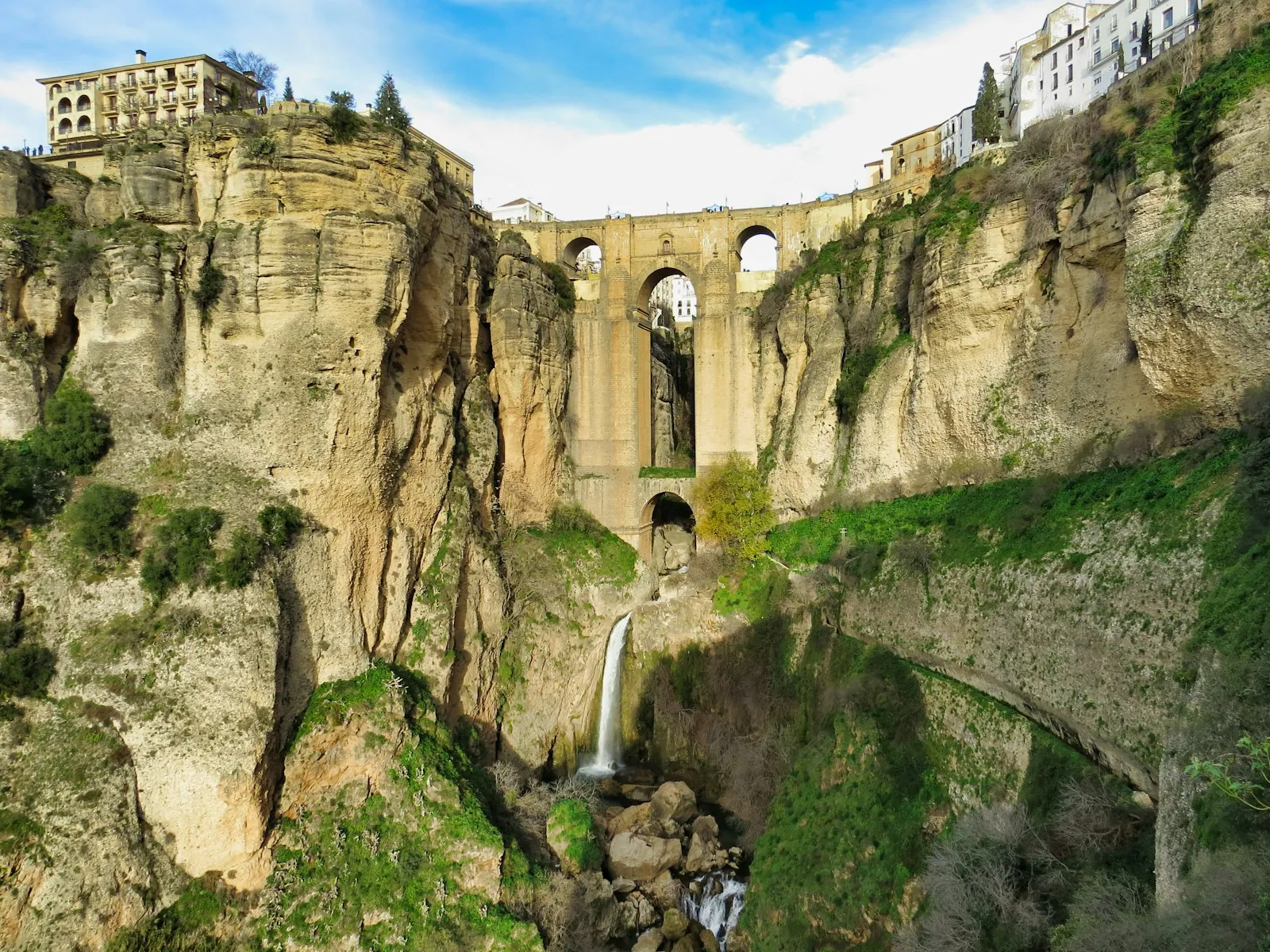
Ronda is one of the most theatrically positioned towns in Europe. It sits on a rocky plateau in the Serranía de Ronda mountains in inland Andalusia, and the town is split in two by a 120-metre-deep gorge (El Tajo) carved by the Río Guadalevín, with the old Moorish town (La Ciudad) on the south side and the newer Mercadillo quarter on the north side. The two halves are connected by three bridges, the most famous of which — the Puente Nuevo, “the new bridge” (built between 1751 and 1793) — is a single 98-metre stone arch spanning the gorge at its narrowest point. The view from the bridge looking down into the gorge, and the view of the bridge from below, are two of the most photographed images in southern Spain. Ronda is also the birthplace of modern bullfighting (the local Real Maestranza is the oldest active bullring in Spain, founded in 1785) and a wine town in its own right (the Sierras de Málaga DO has been quietly producing excellent reds for the last 25 years). It has been a favourite of travelling writers since Goya and Mérimée; Hemingway and Orson Welles both kept houses here. Two days is the right length.
The setup
Drive from Málaga (1 hour 30 minutes), Seville (1 hour 45 minutes), or Granada (2 hours 30 minutes). Or take the train from Algeciras (1 hour 30 minutes, with the train climbing dramatically through the mountains). Stay in central Ronda — Hotel Catalonia Ronda or Parador de Ronda (the latter is built on the cliff edge directly above the gorge, with rooms looking down 100 metres into the canyon).
The town is small and walkable. A car is useful for the white villages day trip.
Day one: the Puente Nuevo and La Ciudad
Walk to the Puente Nuevo first. The bridge is the single most iconic image of the town — a vast pale stone single arch leaping the narrowest point of the El Tajo gorge, with a small chamber inside the central arch (used over the centuries as a town gaol, an audience hall for the architect, and now a small museum that you can visit). Walk across the bridge slowly. Lean over the parapet and look down — the gorge plunges 120 metres straight down to the river bed, and the cliffs on either side are sheer and pale. People take a moment.
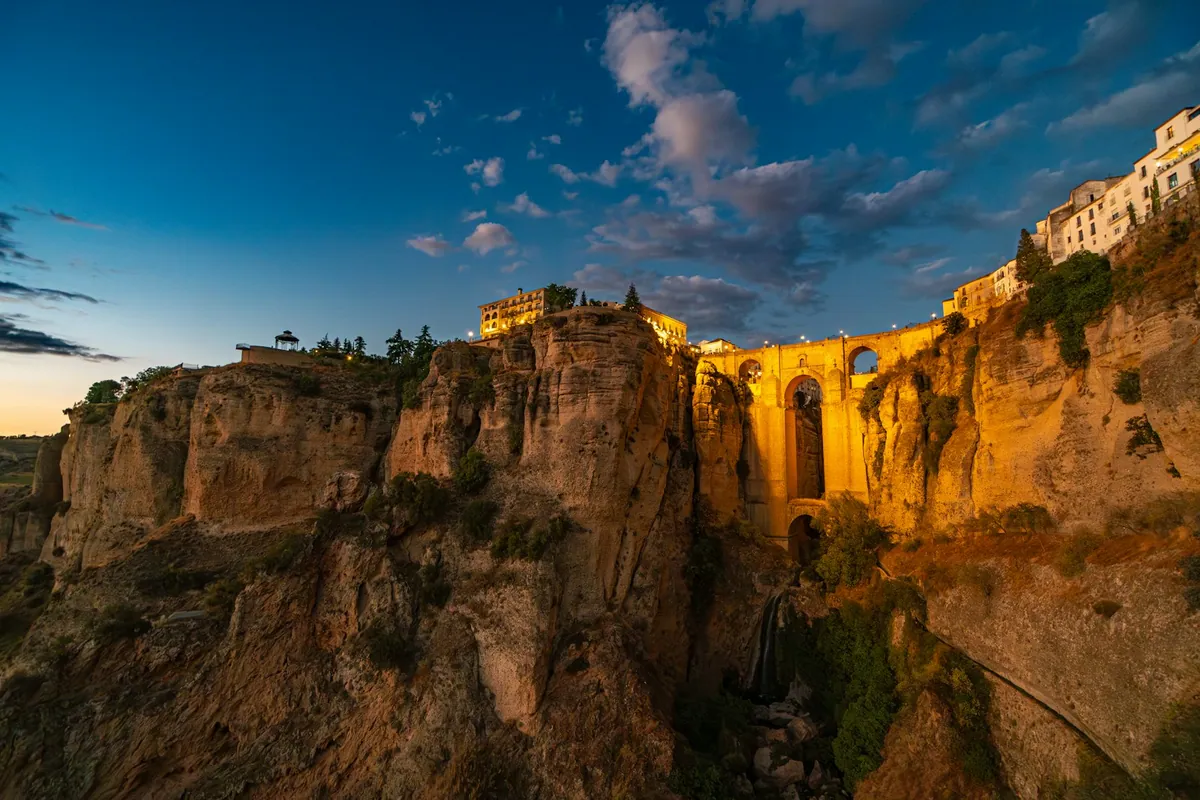
After the bridge, walk into La Ciudad — the old Moorish town on the south side, the original Ronda from the 11th century. The streets here are narrow, white-washed, and quiet. The Iglesia de Santa María la Mayor (a beautiful church built on the site of the city’s main mosque, with the original mihrab still visible behind the high altar) and the Casa del Rey Moro (the “Moorish King’s House,” with extraordinary gardens designed by the French architect Jean-Claude Forestier in the 1910s, and a restored 14th-century Moorish stairway that descends 200 metres through the rock to the river at the foot of the gorge — the famous Mina, a defensive water-gathering passage from the Moorish period) are the two architectural anchors of the old town.
The Mondragón Palace is the headline visit. A 14th-century Moorish royal palace later modified by Christian builders, it has a beautiful courtyard with horseshoe-arched arcades, a small museum of regional archaeology, and views from the terrace down across the Andalusian plain to the south. Allow ninety minutes.
For lunch, eat in La Ciudad. Reliable: Pedro Romero (the historic restaurant of the bullfighting tradition, opposite the bullring on the other side of the bridge — the rabo de toro is the famous dish), Tragatá (a contemporary tapas bar from the Cervecería La Mancha team), or any of the smaller bistros on the small streets behind Santa María.
Day one afternoon: the bullring, the Alameda, and the gorge from below
The Plaza de Toros de Ronda — the bullring, on the north side of the bridge in the Mercadillo quarter — is one of the most important in Spain. Founded in 1785, it’s the oldest active bullring in the country, and the Romero family of Ronda effectively codified the modern style of bullfighting (specifically, fighting on foot rather than from horseback) here in the late 18th century. The bullring building is a beautiful neoclassical arena — open to visitors year-round, with a small museum of bullfighting attached. Allow an hour. Whether or not you have any interest in the bullfighting tradition, the architecture is worth the visit.
After the bullring, walk along the Alameda del Tajo — a small park along the cliff edge with a famous viewing balcony (the Balcón del Coño, named for the regular gasps of arriving visitors who first see the view) that gives you the panoramic view across the Andalusian plain to the south. The Parador hotel terrace next door is a lovely spot for a coffee.
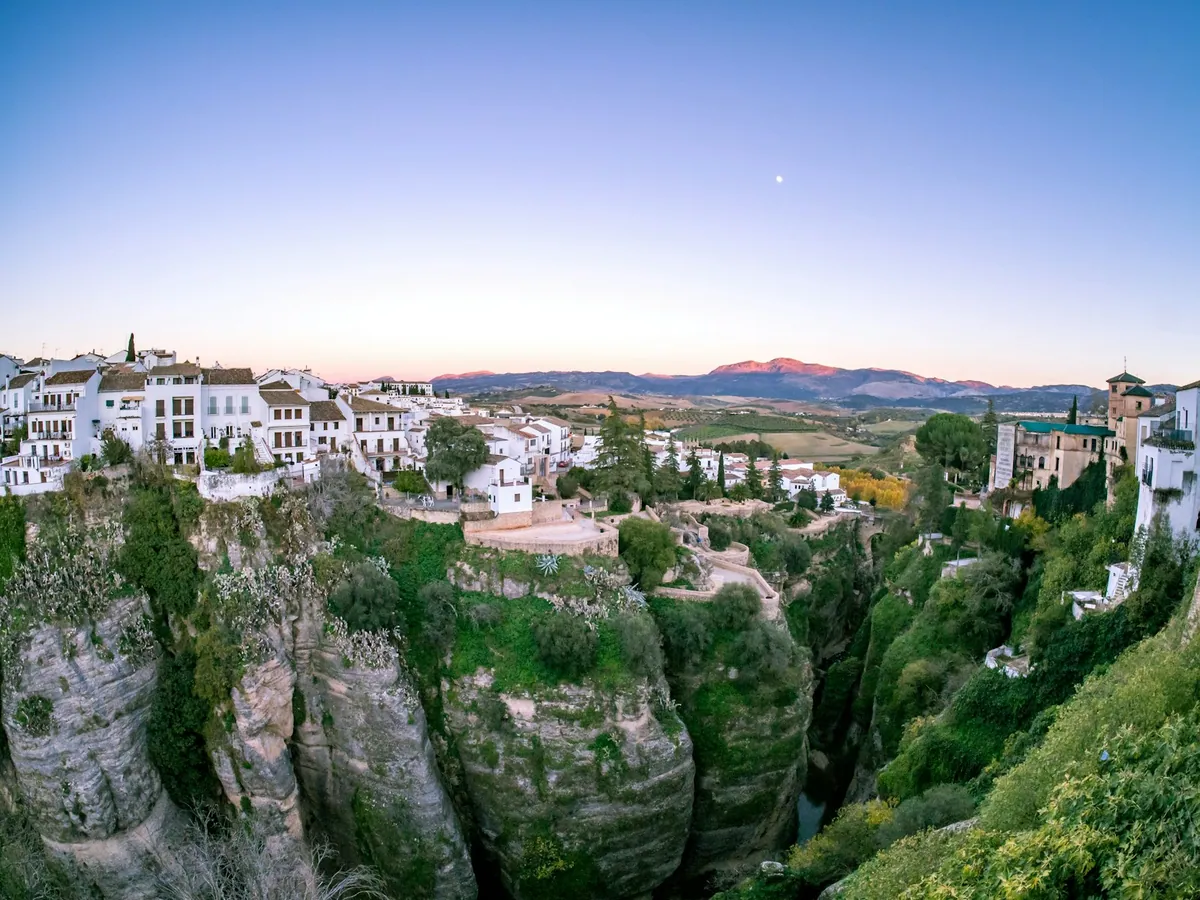
In the late afternoon, walk down into the gorge from below — the path leaves from the northern end of the gorge near the Plaza María Auxiliadora and descends along the river. The walk takes about 45 minutes round trip and gives you the iconic view of the Puente Nuevo from beneath, looking up at the bridge against the sky. The walk back up is steep but rewarding.
For dinner, eat at one of the small bistros in the Mercadillo or back over in La Ciudad. Bardal (one Michelin star — actually two — the city’s destination restaurant) is the splash-out; Almocábar (in the Barrio de San Francisco, the third historic neighbourhood, south of the old town) is a more relaxed traditional Andalusian place.
Day two: the white villages
Day two is for the Pueblos Blancos — the white villages of the Sierra de Grazalema and the Sierra de Cádiz, the network of small white-washed mountain villages in the hills around Ronda. They are some of the most picturesque small towns in Spain.
Drive (or take a small-group day tour from Ronda) along the well-marked Pueblos Blancos route. A typical day visits three or four villages; the headlines are Setenil de las Bodegas (famous for houses built into and under the natural rock overhangs of the gorge that runs through the village; the main streets have stone roofs of overhanging cliff), Zahara de la Sierra (a small white village clinging to a hillside above a turquoise reservoir, with a Moorish castle on top), Grazalema (a beautifully kept mountain village in the centre of the natural park, the wettest place in mainland Spain — a quirk of the surrounding mountains creates a microclimate that catches the Atlantic-moist west winds), and Olvera (a striking white village topped by a Moorish castle and a 19th-century church on a hill above the surrounding plain).
Each village merits 45 minutes to an hour. Have a long lunch in one of them — Mesón El Olivar in Zahara de la Sierra is a serious traditional Andalusian restaurant, or Restaurante Mesón Las Caleras in Setenil. Drive between villages on the small mountain roads, stopping at miradores along the way.
How nice are Rondeños?
Slow-warm. Ronda is a small town with a strong identity — the bullfighting heritage, the Goya and Hemingway connections, the wine — and the local welcome is warm and patient. Within two days I had: a hotel concierge walk me ten minutes to a small wine shop with a particular bottle she wanted me to try; a small restaurant owner give me an extra half-portion of his rabo de toro because “you ate the first portion fast, you need a little more”; and a bullring guide stay an extra ten minutes after the closing bell to point out a small detail of the arena’s 18th-century architecture I’d asked about. Ronda’s warmth is the small-town Andalusian variety — patient, generous, real.
If you go
• Two days minimum. One is the day trip; two is the trip. • Hire a car for the Pueblos Blancos. Public transport between them is limited. • Visit between October and June. July and August are very hot. • Walk down into the gorge from below. The view of the Puente Nuevo from underneath is the experience. • Eat the rabo de toro (oxtail stew) — Ronda’s great traditional dish.
Ronda is one of the most theatrically beautiful small towns in Spain. Two days here will give you the gorge, the bridges, the Moorish old town, and the white villages of the surrounding mountains. You leave with the photograph and a slight wish for a third day.