San Sebastián in Three Days: Pintxos, La Concha and the Basque Country
Three days in the foodie capital of Spain — the perfect city beach, the pintxos crawl, and the green hills of the Basque Country.
📍 San Sebastián, Spain
San Sebastián — Donostia in Basque, the local language and the name you will see on every road sign — is a small city of about 190,000 people on the north coast of Spain, 20 kilometres from the French border, and it is the unofficial culinary capital of the country. By Michelin-star count per square kilometre, it is one of the most decorated places to eat anywhere in the world. The headline restaurants (Arzak, Akelarre, Mugaritz, Berasategui, Elkano) have collectively held more than 20 stars. The pintxos bars in the Old Town serve some of the most ambitious bar food on Earth — small, beautiful, often technically extraordinary plates, eaten standing up at a counter, washed down with a sharp local Txakoli white wine poured from height. Around the food, the city itself is a perfect Belle Époque seaside resort: the world-famous La Concha bay, a perfect crescent of beach right in the middle of town; the Old Town packed against the harbour at the eastern end; the surfers’ Zurriola beach on the other side of the river; and the green hills of the Basque country rising directly from the sea on either side of the bay.
Three days will give you the soul of the place. You can do two if you’re only there for the food.
The setup
Fly into San Sebastián (small airport at Hondarribia, 30 minutes from the centre) or fly into Bilbao (1 hour 15 minutes by bus from Bilbao airport to San Sebastián). Or take the train from Madrid (5 hours, comfortable). Stay in or near the Old Town (Parte Vieja) or in the Centro neighbourhood near La Concha. Mid-range hotels run €120–250 a night. Avoid late August — that’s the San Sebastián International Film Festival and the city books out and prices spike.
The city is small and walkable. Buses cover the further beaches and Mt Igueldo.
Day one: La Concha and Mt Igueldo
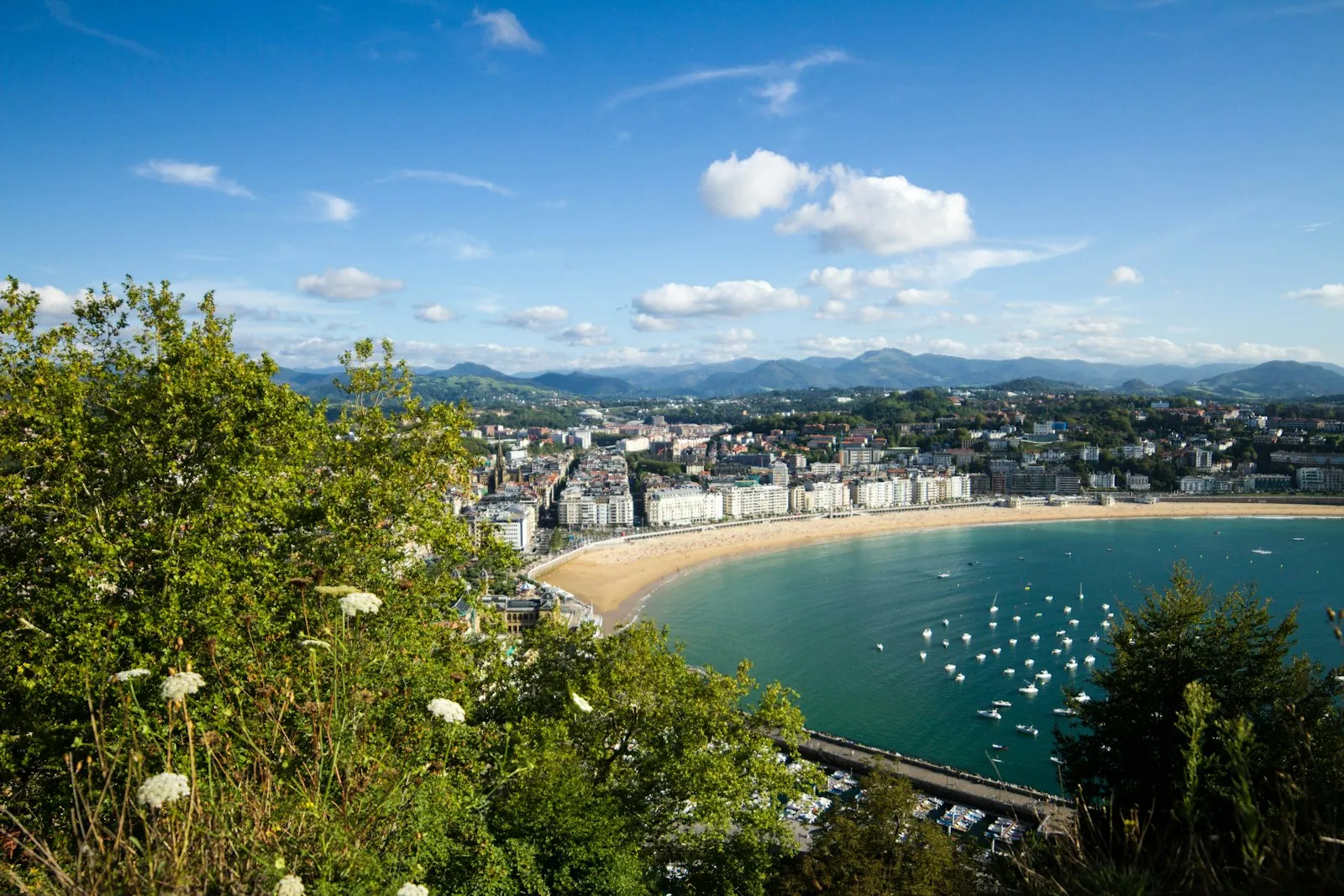
Walk to La Concha first. The bay is a perfect U-shape, two kilometres of pale gold sand wrapped between the headland of Mt Urgull at the eastern end and Mt Igueldo at the western end, with a small island (Isla de Santa Clara) in the middle. The promenade above the beach (the Paseo de la Concha) is one of the great urban beach walks anywhere — wide, flat, beautifully maintained, with the white wrought-iron Belle Époque railings that have become a city symbol. Walk the entire length, from the Old Town past the Hotel Maria Cristina and the Royal Palace at Miramar, all the way to the western end at the Peine del Viento (the famous wind-comb sculpture by Eduardo Chillida).
Take the historic 1912 funicular to the top of Mt Igueldo. The funicular is a small wooden cog railway that climbs the western headland in 3 minutes; at the top there’s a small old amusement park (still open, still using some of its original 1912 rides) and a panoramic platform that gives you the full postcard view of La Concha and the Old Town below. Cost: about €4 each way. Allow 90 minutes for the climb and the views.
In the afternoon, swim. La Concha is a calm, gentle bay (the small island in the middle and the narrow harbour mouth break the swell), and the water is the right temperature from June through September. Find a sun-lounger from one of the beach concessions and spend the afternoon.
Day one evening: the pintxos crawl
The pintxos crawl is the absolute centre of the San Sebastián experience. The Old Town (Parte Vieja) — about ten square blocks of narrow cobbled streets at the foot of Mt Urgull, packed with small bars — is the heart of the operation, with maybe 70 pintxos bars in walking distance. Each bar has 10–30 different pintxos laid out on the counter and a smaller chalkboard menu of hot pintxos cooked to order. You order one or two at each bar, eat them standing up at the counter, drink a small glass of beer, wine, or cider, and move on to the next bar. The pattern is to walk between three or four bars in an evening.
Reliable spots: La Cuchara de San Telmo (small kitchen, ambitious cooking, the famous slow-cooked beef cheek pintxo), Bar Néstor (the famous tortilla — they make exactly two a day at 1 p.m. and 8 p.m., and you have to queue twenty minutes ahead of each opening to get a slice), Atari Gastroteka (great wine bar pintxos), Borda Berri (rabo de toro and creamy risotto pintxos), Bar Sport (older, more traditional, the famous foie gras pintxo), Goiz Argi (the prawn skewers).
Order a Txakoli (the local sharp dry white wine, served chilled, poured from a height of two feet to aerate it — the bartender will do the show, you don’t need to ask). Or a Sidra (the Basque cider, similar tradition of pouring from height). Eat a pintxo. Walk to the next bar. Continue until full or tipsy.
Day two: a slow morning, the Zurriola surf beach, San Telmo Museum
Sleep in. Have a long breakfast at one of the cafes on Plaza de la Constitución or in the Centro neighbourhood.
In the morning, walk to the Zurriola beach on the other side of the Urumea river — the surf beach, the younger and more bohemian counterpart to the resort-elegant La Concha. The waves here are bigger (it’s an Atlantic-facing beach, not a sheltered bay), the surf school crowd is thicker, and the small cafes along the promenade are more bohemian. Watch surfers for an hour. Swim if you’re a confident swimmer (the rip currents are real). Eat a midday lunch at one of the surf-cafe-restaurants on the promenade.
In the afternoon, visit the San Telmo Museoa — the Basque cultural museum, housed in a beautifully restored 16th-century convent at the foot of Mt Urgull. Permanent collection covers Basque history, ethnography, and art. Allow ninety minutes.
For dinner, do another pintxos crawl in different bars (don’t repeat day one’s bars; the variety is the point), or book a table at one of the city’s serious sit-down restaurants. The Michelin-starred destinations require booking weeks ahead. For a more accessible reference dinner, try Casa Urola, Galerna, or one of the Old Town’s tabernas.
Day three: a day trip — Hondarribia, Getaria, or San Juan de Luz
Day three is for an out-of-town trip. Three good options:
Hondarribia, 25 minutes east by bus, is a beautifully preserved fortified town on the French border, with a small old town inside the walls, a fishing port, and several excellent pintxos bars (especially Calle San Pedro). A half-day visit.
Getaria, 35 minutes west by bus, is a small fishing village famous for its grilled turbot — the local catch is grilled whole over wood fires on the harbourfront, and the destination restaurant Elkano (one Michelin star, the spiritual home of grilled fish) is one of the great food experiences in the Basque country. Get the bus, eat a long lunch on the harbour, drink a glass of Txakoli (Getaria is the centre of Txakoli production), and bus back.
Saint-Jean-de-Luz, 40 minutes east across the French border, is the Basque coastal town on the French side. Beautiful beach, lively harbour, French-Basque cuisine. Bring your passport (no border check, but be prepared) and the right currency.
End your trip with one final pintxos crawl in the Old Town. Then bed. Then home.
How nice are Donostiarras?
Basque-warm. The Basque country has its own strong cultural identity (and its own language, Euskara, unrelated to any other living language) and the locals are slightly more reserved than southern Spaniards but generously warm once you’ve been there a day. Within three days I had: a Bar Néstor staff member quietly slip me an extra slice of the famous tortilla because I’d been waiting in the line patiently; a museum guide at San Telmo extend his afternoon tour by twenty minutes for our small group; and a pintxos bar owner refuse to let me pay for the third Txakoli of the night “because you ate well, you tipped well, you’re alright.” The Basque hospitality is real, occasionally cool on first contact, and very warm by the second.
If you go
• Three days minimum. Two is short. One is a pintxos visit. • Eat a late dinner. The Spanish tradition. The pintxos bars are at their busiest from 8:30 to 11 p.m. • Don’t skip Mt Igueldo. The view of La Concha from the top is the photograph. • Book Michelin-star restaurants weeks in advance. • Drink the Txakoli. It pairs perfectly with the pintxos and is rarely available outside the Basque country.
San Sebastián is one of the great small cities in Europe. Three days here will give you the perfect city beach, the famous pintxos crawl, and the day trips into the Basque country. You leave with a list of return dates already in your head.